

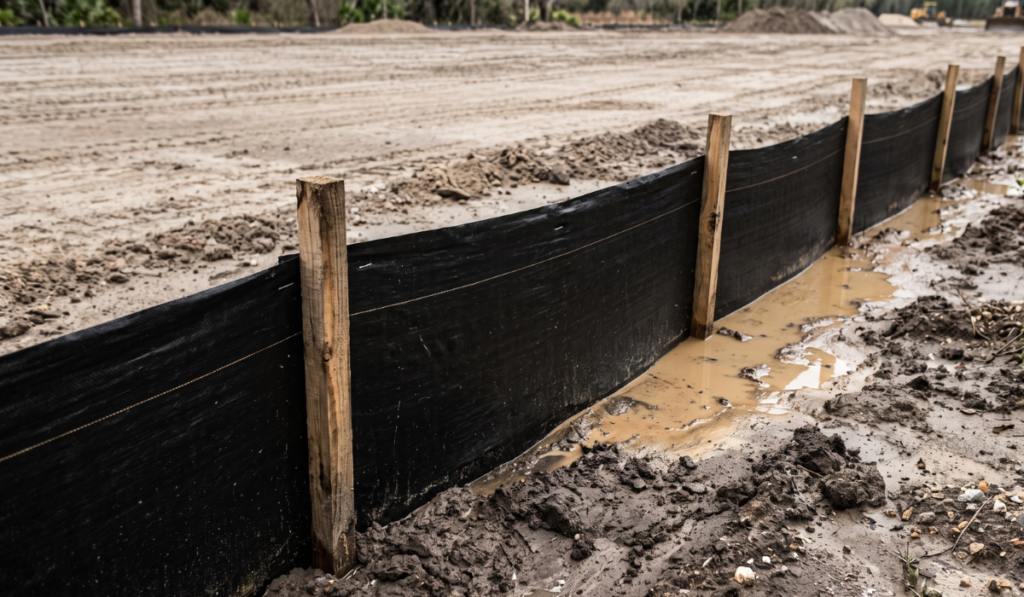
Site drainage on Manatee County construction sites is most vulnerable during Florida's rainy season, which runs June through September with peak storm intensity in July and August, a window when cleared and graded sites have disturbed soil exposed but permanent drainage infrastructure is not yet in place. A single major storm event during this window can undo weeks of grading work, trigger county inspection violations, and introduce erosion damage that costs significantly more to correct than it would have cost to prevent. This post covers what SWFWMD and Manatee County require for erosion control on active construction sites, where those requirements are most commonly misapplied, and what a properly protected site looks like compared to one that was not prepared correctly before the rains arrived.
Erosion Control and Stormwater Protection for Manatee County Construction Sites During Florida's Rainy Season
Why Cleared and Graded Sites Are the Most Vulnerable
Undisturbed land handles rainfall through root systems, organic material, and established soil structure that absorb and slow water movement. A cleared and graded construction site has none of those systems in place. The exposed mineral soil surface is erodible, the drainage patterns have been altered by grading activity, and there is no vegetative cover to intercept rainfall before it hits the ground.
Florida's rainy season compounds this vulnerability. Manatee County receives the majority of its annual rainfall between June and September, with afternoon convective storms that can deliver two to four inches of rain in under an hour. A site that looks stable the morning before a storm can be significantly eroded by the time that storm passes.
The sites most at risk are those in an intermediate state: cleared but not yet graded to final design, or graded but waiting on utility installation before permanent vegetation or paving can be established. Those windows can extend for weeks or months in an active construction schedule, and that is exactly the window when erosion control has to be working correctly.
What Manatee County and SWFWMD Actually Require
Erosion and sediment control on Manatee County construction sites is governed by two overlapping regulatory frameworks: Manatee County's local stormwater and construction site requirements, and the Southwest Florida Water Management District's Environmental Resource Permit (ERP) standards that apply to projects meeting certain size and disturbance thresholds.
Under these frameworks, active construction sites are required to install and maintain erosion and sediment controls before land disturbance begins, not after the first storm reveals a problem. The required measures for most residential and commercial construction sites in Manatee County include:
- Silt fence along the downslope perimeter of the disturbed area
- Inlet protection on all storm drain inlets within or adjacent to the project boundary
- Stabilized construction entrance at all points where vehicles exit the site onto public roadways
- Temporary seeding or mulching on graded areas that will not be disturbed for 14 days or more
- Sediment basin or trap on larger sites where concentrated flow requires additional treatment before leaving the property
These controls have to be inspected regularly and maintained throughout the construction period. Installing them at setup and ignoring them through the rainy season is not compliance — it is the most common pattern that results in county violation notices on active Manatee County job sites.
Common Installation Mistakes That Trigger County Violations
The difference between erosion controls that work and erosion controls that fail inspection is usually not the materials, it is the installation details. These are the most frequent mistakes that result in Manatee County notices of violation on construction sites during the rainy season.
| Control Measure | Common Mistake | Why It Fails |
|---|---|---|
| Silt fence | Laid on the surface and staked without trenching the bottom edge into the ground | Water undermines the fence at the base, sediment passes through without resistance |
| Silt fence | Installed across a concentrated flow path rather than on the contour | Water pools, pressure builds, and the fence fails at the lowest point |
| Inlet protection | Undersized for the drainage area contributing to the inlet | Overwhelmed during peak storm intensity, sediment bypasses protection and enters the storm system |
| Construction entrance | Too short or too narrow for the vehicle types exiting the site | Mud tracks onto the public road, an automatic violation under Manatee County standards |
| Temporary seeding | Applied but not watered or monitored — fails to establish before the rainy season | Bare soil remains exposed; no vegetative cover to intercept rainfall on disturbed areas |
Before and After: What a Storm Event Reveals About Site Preparation
Consider two identical graded residential lots in Manatee County, both cleared and brought to rough grade in late June ahead of the peak rainy season. Both have the same soil type and the same drainage design. The difference is in how erosion controls were installed.
The site without proper controls: Silt fence was installed along the front property line but not trenched in. The rear of the lot, which slopes toward an adjacent swale, has no perimeter protection. After the first significant storm in July, sediment has migrated into the adjacent drainage swale, the silt fence has blown out at two low points, and a rill erosion channel has developed across the graded pad surface where concentrated flow found an unprotected path. A county inspector visits and issues a violation notice. The contractor has to stop grading activity, restore the eroded areas, reinstall controls correctly, and schedule a re-inspection before work can resume.
The site with properly installed controls: Silt fence is trenched in along the full downslope perimeter, inlet protection is installed on the adjacent swale inlet, and the construction entrance has adequate stone depth and width. After the same storm, the graded pad surface shows minor surface wash consistent with expected rainfall but no rill erosion, no sediment in the adjacent drainage system, and no fence failures. The inspector visits, confirms controls are functioning, and the project continues on schedule.
The cost difference between those two outcomes is the cost of the violation response, re-inspection scheduling, and lost construction time, none of which appear in the original site prep budget but all of which are predictable consequences of installation shortcuts.
Our site preparation services include erosion control installation and maintenance through the construction period, not just at setup. For projects that include grading and excavation where drainage design integration matters from the start, visit our excavation and grading services page. You can also review our full service capabilities on the Wingard Land Services services page.
Frequently Asked Questions About Site Drainage and Erosion Control in Manatee County
When does Florida's rainy season peak in Manatee County?
Florida's rainy season in Manatee County runs June through September, with the highest storm intensity and frequency occurring in July and August. Afternoon convective storms during this period can deliver significant rainfall in a short time window, which is why cleared and graded construction sites are most vulnerable during this period before permanent drainage infrastructure and vegetation are established.
What erosion controls are required on construction sites in Manatee County?
Manatee County and SWFWMD requirements for active construction sites typically include silt fence along the downslope perimeter, inlet protection on all storm drain inlets within or adjacent to the project boundary, a stabilized construction entrance at all vehicle exit points, and temporary seeding or mulching on areas that will not be disturbed for 14 days or more. Requirements vary based on project size, disturbance area, and proximity to wetlands or water bodies. All controls must be installed before land disturbance begins and maintained throughout the construction period.
What triggers a stormwater violation on a Manatee County construction site?
Common triggers for stormwater violation notices on Manatee County construction sites include sediment tracked onto public roadways, silt fence that has failed or was not properly installed, unprotected storm drain inlets, bare soil on disturbed areas that have been inactive for more than 14 days without temporary cover, and sediment discharge into adjacent drainage systems or water bodies. Violations can result in stop-work orders and required corrective action before construction activity can resume.
Does SWFWMD require a separate permit for stormwater management on construction sites in Manatee County?
Yes, for projects that meet certain disturbance thresholds. The Southwest Florida Water Management District requires an Environmental Resource Permit for projects disturbing one acre or more, or smaller projects that meet other criteria related to proximity to wetlands or water bodies. The ERP establishes stormwater treatment and attenuation standards that the site drainage design must meet before the permit is issued. Wingard Land Services is fully registered with Florida municipalities and coordinates permitting requirements including SWFWMD applications as part of applicable project scopes.
Have an active or upcoming construction site in Manatee County that needs erosion control or site drainage coordination before the rainy season peaks? Contact our team for a free estimate.
Get a Free Estimate