

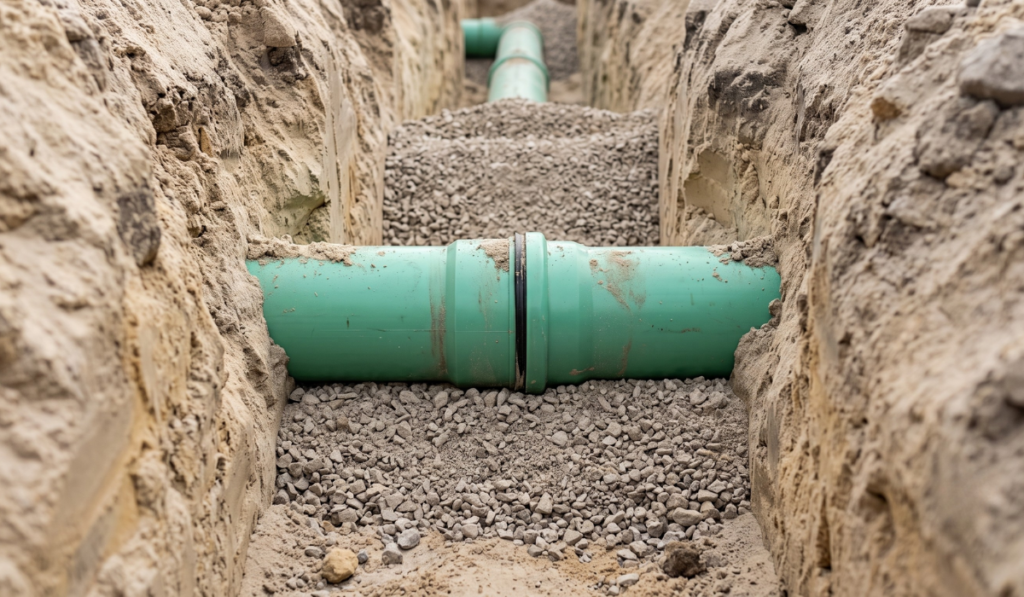
Underground utility installation in Florida is governed by minimum cover depth requirements, mandatory horizontal and vertical separation distances between utility types, and staged inspection requirements that must be met before backfill is permitted to proceed, and misunderstanding any one of these three areas produces failures that range from a failed inspection and re-excavation to a public health code violation that outlasts the construction project. This post covers the three aspects of underground utility installation that property owners and developers most commonly misunderstand, what the Florida Department of Environmental Protection and local utility authority requirements actually require, and what the difference looks like between a correctly installed utility corridor and one built around shortcuts.
The Three Most Misunderstood Aspects of Underground Utility Installation in Manatee County and Beyond
Misunderstanding 1: Minimum Cover Depth Is a Single Number
The most common misconception about utility depth requirements in Florida is that each utility type has one minimum depth that applies universally. In practice, minimum cover depth requirements vary based on the utility type, the material of the pipe or conduit, the load conditions above the line, and whether the installation is under a paved surface, a travel lane, a landscaped area, or an open field.
A waterline that meets minimum depth requirements in a landscaped area may be too shallow to install under a roadway or parking lot where surface load calculations apply. A sanitary sewer lateral installed at the correct depth for a gravity-flow residential connection may not meet the cover requirements for a pressurized force main on the same property.
The practical implication is that the contractor responsible for underground utility installation needs to be reviewing the project's civil drawings and the applicable local utility authority standards, not applying a single generic depth to every trench on the site. Depth decisions that look correct to an untrained eye can fail inspection when the inspector applies the correct standard for the specific utility type and installation condition.
Misunderstanding 2: Separation Requirements Are Just About Physical Space
Required separation distances between underground utility types are not simply a spacing preference. For sanitary sewer and potable waterlines specifically, separation requirements exist because of cross-contamination risk, and violating them is a public health code issue governed by the Florida Department of Environmental Protection, not just a local building code matter.
Florida's Chapter 62-555 and Chapter 62-604 administrative codes, administered by the Florida DEP, establish minimum separation requirements between water distribution systems and sanitary sewer collection systems. The general horizontal separation requirement between a potable waterline and a sanitary sewer is ten feet. Where ten feet cannot be achieved, specific construction criteria apply, including pressure class requirements for the water main, joint spacing requirements, and encasement conditions, that must be documented and approved before installation proceeds.
Vertical separation requirements apply when a waterline must cross over or under a sewer line. The waterline must pass over the sewer with a minimum eighteen-inch vertical clearance in most cases. Where that clearance cannot be achieved, encasement and additional joint spacing requirements apply.
Contractors who install utilities without verifying these separation requirements against the as-built conditions of the site, not just the design drawings, create installations that fail DEP review, require complete re-excavation of the affected corridor, and in some cases trigger notification requirements to the local utility authority and health department.
Misunderstanding 3: Inspection Happens at the End
Property owners who have not been through a utility installation project before often assume that inspection is a final step, something that happens after the trench is backfilled and the site is cleaned up. In Florida, that assumption produces failed projects.
Underground utility installation in Manatee County and across Florida involves staged inspections at specific points in the installation process, most critically before backfill begins. The pre-backfill inspection confirms that pipe is set at the correct elevation and alignment, bedding material is placed and graded correctly under the pipe, joints are properly assembled, and separation distances from other utilities are verified in the field.
If a contractor backfills before the pre-backfill inspection is completed and approved, the inspector has no way to verify what is buried. The standard result is a required excavation of the installed line, at the contractor's cost, to allow the inspection to occur. In Manatee County, where permit review and inspection scheduling are affected by the volume of active construction, contractors who do not schedule inspections in advance compound the problem by waiting on an inspection slot after work that should not have been covered has already been buried.
What a Correctly Installed Utility Corridor Looks Like vs. Common Shortcuts
| Installation Element | Correct Installation | Common Shortcut and Its Consequence |
|---|---|---|
| Trench bedding | Compacted granular bedding material placed and graded to uniform pipe support elevation | Native soil used as bedding: pipe settles unevenly, slope is lost, flow problems develop |
| Waterline and sewer separation | Ten-foot horizontal separation verified in field against as-built utility locations | Separation measured from design drawings without field verification, actual separation less than required, DEP violation |
| Pre-backfill inspection | Inspection scheduled in advance, pipe open and accessible, elevation verified before backfill | Backfill placed before inspection: re-excavation required, project delayed and costs added |
| Pipe joint assembly | Joints assembled per manufacturer specification with correct lubricant and insertion depth | Joints pushed together without full engagement, leak path at joint fails pressure test |
| Backfill compaction | Placed in lifts with compaction verified to prevent pipe deflection and surface settlement | Backfill dumped and compacted in a single pass, pipe deflects under load, road or pad settles above line |
What to Confirm Before Any Underground Utility Work Begins on Your Florida Project
Before an underground utility contractor mobilizes on a residential or commercial project in Manatee County or anywhere in Florida, these are the questions that protect the project from the most common and costly failures:
- Has the contractor reviewed the civil drawings and confirmed depth requirements against the specific utility type and installation condition at this site?
- Have existing utility locations been verified in the field, and has separation from the proposed installation been confirmed against DEP Chapter 62 requirements?
- Is the pre-backfill inspection scheduled with the local utility authority or building department before trench work begins?
- What bedding material is specified, and how is compaction being documented before and after backfill?
- Is the contractor registered with Florida municipalities and familiar with the local inspection process for this utility type?
Our underground utility installation services are managed with full inspection compliance at every stage, from permit coordination through final sign-off. For projects where utility installation is part of a broader site preparation scope, visit our site preparation services page to see how we coordinate both phases. A full overview of our capabilities is available on the Wingard Land Services services page.
Frequently Asked Questions About Underground Utility Installation in Florida
What is the required separation between a waterline and sewer line in Florida?
Florida's DEP Chapter 62-555 and Chapter 62-604 administrative codes require a minimum ten-foot horizontal separation between potable water distribution lines and sanitary sewer collection lines. Where ten feet cannot be achieved, specific construction criteria apply including pressure class requirements, joint spacing, and encasement conditions that must be approved before installation proceeds. Vertical separation of at least eighteen inches is required when a waterline crosses over a sewer line.
When does a utility inspection happen during underground installation in Manatee County?
Underground utility installation in Florida requires staged inspections, most critically a pre-backfill inspection that must be completed and approved before the trench is covered. This inspection verifies pipe elevation, alignment, bedding, joint assembly, and separation distances in the field. Contractors who backfill before the pre-backfill inspection is approved face mandatory re-excavation of the installed line. Scheduling inspections in advance is essential in Manatee County's active construction market where inspection slots are not always immediately available.
What are the most common reasons underground utility installations fail inspection in Florida?
The most common inspection failure points on Florida underground utility projects are insufficient pipe cover depth for the specific installation condition, separation distances between utility types that do not meet DEP requirements in the field, backfill placed before the pre-backfill inspection, improper bedding material or bedding grade, and joint assembly that fails pressure testing. Each of these failures requires re-excavation of the affected section, which adds cost and delays the project timeline.
Does sewer line installation in Manatee County require a separate permit from the building permit?
Yes. Sanitary sewer installation in Manatee County typically requires a utility permit issued through the local utility authority in addition to any building permits associated with the project. The utility permit governs the installation standards, inspection requirements, and connection authorization for the sewer line. Water distribution lines require a separate permit from the applicable water utility authority. Wingard Land Services is fully registered with Florida municipalities and coordinates all required permits as part of every underground utility scope.
Have an underground utility project in Manatee County or elsewhere in Florida? Contact our team for a free estimate and a direct conversation about what your site and utility scope require.
Get a Free Estimate