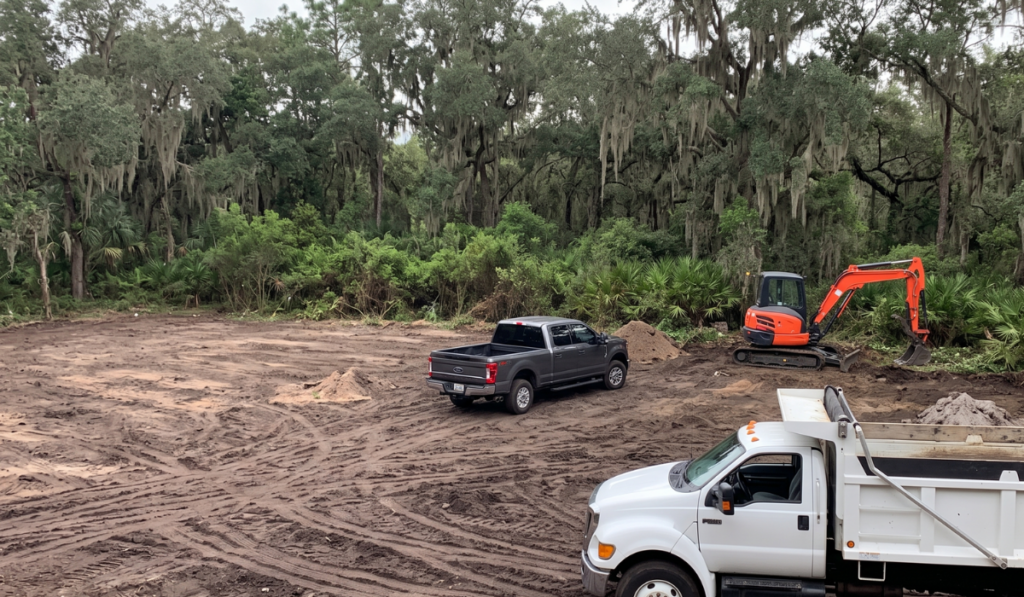
Building demolition contractors in Duette and rural Manatee County face project conditions that suburban and coastal contractors encounter occasionally at best — unpaved access roads with weight restrictions, agricultural structures built from materials that require different demolition methods, large acreage with no established equipment staging area, and permit requirements specific to unincorporated county jurisdictions that differ from what applies inside Bradenton or Palmetto city limits. Treating a Duette farm property teardown the same way you would approach a residential demolition on a cleared suburban lot is one of the fastest ways to turn a straightforward project into an expensive one. This post covers what makes rural demolition in Duette genuinely different and what property owners need to understand before hiring a contractor.
Rural Demolition in Duette and Manatee County: Access, Equipment, Permits, and Agricultural Structure Considerations
The Access Problem That Suburban Contractors Do Not Anticipate
Most demolition contractors who work primarily in Bradenton, Sarasota, or coastal Manatee County are accustomed to paved road access within a short distance of every job site. Rural properties in Duette do not always provide that. Unpaved county roads and private access easements serving rural parcels may have weight restrictions that limit what equipment can be driven in without damaging the road surface or violating county road use rules.
Sending a heavy excavator down an unpaved easement without confirming the road condition and weight tolerance is the kind of mistake that results in a stuck machine, a damaged access route, and a bill for road restoration that the property owner was not expecting. It also affects the project schedule — a machine that cannot reach the site cannot do the work.
Contractors who work in Duette regularly know to assess the access route before mobilizing, confirm weight limits on any county roads involved, and select equipment that can reach the site and perform the work without compromising the access corridor. That assessment is part of the pre-project planning process, not something discovered on the first day of work.
Agricultural Structure Materials Require Different Demolition Methods
A concrete block farmhouse, a steel-framed pole barn, a metal-roofed equipment shed, and a wood-frame agricultural storage building are four different demolition problems. Each requires different equipment, different debris sorting and disposal logistics, and different handling for any materials that may require separate disposal streams.
Metal roofing and structural steel from agricultural buildings cannot be handled the same way as wood framing. Steel requires shearing or cutting equipment and a separate haul-off stream from concrete and wood debris. Pole barn foundations, which are often concrete footings embedded several feet below grade, require excavation to confirm full removal rather than simple surface-level demolition.
Pre-1980 agricultural structures in Manatee County may also contain asbestos in roofing materials, insulation, and pipe lagging that would not be present in a newer metal building. Federal NESHAP regulations apply to agricultural structures the same as they do to residential and commercial buildings — a thorough inspection by an accredited inspector is required before demolition of any structure where regulated materials may be present, regardless of the structure type or use.
Contractors who work primarily on residential teardowns in suburban markets may not have the shearing attachments, the debris sorting experience, or the hazmat survey coordination process to handle these conditions correctly on a Duette agricultural property.
How Permit Requirements Differ in Unincorporated Manatee County
Properties in Duette fall within unincorporated Manatee County, which means permits are processed through Manatee County Building and Development Services rather than a municipal building department. That distinction matters in practice.
Agricultural structure demolition in unincorporated Manatee County may qualify for different permit treatment than a residential or commercial demolition inside city limits — but only under specific conditions. Florida Building Code exemptions for agricultural buildings apply to structures used exclusively for agricultural purposes on bona fide agricultural land. Structures that have been converted to residential, storage, or other non-agricultural uses, or that sit on parcels no longer classified as agricultural for tax purposes, may not qualify for those exemptions and require a standard demolition permit.
Property owners who assume their structures qualify for an agricultural exemption without confirming that with Manatee County risk beginning demolition without the required permit — a stop-work order and potential fine scenario that adds time and cost to a project that was supposed to be straightforward.
What property owners in Duette should gather before contacting the county: the property's current land use classification, the tax parcel designation, the age and original use of each structure being demolished, and any documentation of prior conversions or change-of-use. A contractor with regular experience in unincorporated Manatee County can review this information and advise on what permit pathway applies before the application is submitted.
Equipment Selection on Large Rural Parcels
Equipment selection for a rural demolition in Duette is not the same decision as it is on a standard residential lot. Large acreage with multiple structures spread across the parcel, no established equipment staging area, and soil conditions that change between wet and dry season all affect which machines are the right choice and in what sequence they should be deployed.
| Structure or Condition | Appropriate Equipment | Why the Standard Suburban Option Falls Short |
|---|---|---|
| Concrete block farmhouse | Mid-size excavator with demolition bucket or shear | Smaller residential demolition machines lack the reach and force for dense masonry |
| Steel pole barn | Excavator with shear attachment for steel cutting | Standard demolition buckets cannot process structural steel efficiently |
| Soft or wet soil access routes | Tracked equipment matched to ground bearing capacity | Wheeled machines or undersized tracked equipment sink or bog on saturated rural soil |
| Multiple structures across large acreage | Equipment staged centrally with planned movement sequence | No staging plan results in repeated repositioning that adds time and fuel cost |
| Embedded pole barn footings | Excavator with bucket for footing extraction | Surface-only demolition leaves embedded concrete that affects grading and future construction |
Before and After: A Duette Agricultural Demolition Scope Done Right vs. Rushed
Consider a ten-acre Duette property with an older farmhouse, a pole barn, and two equipment sheds being cleared for sale or redevelopment. A contractor unfamiliar with rural conditions mobilizes a standard residential demolition machine, discovers the access road cannot support the haul truck weight, and has to call a smaller truck for multiple additional haul trips. The pole barn steel is left on site because the contractor does not have the shearing equipment to process it. The farmhouse is demolished but the slab remains because it was not in the original scope. Two months later, the property owner is managing three separate follow-up contractors to finish what should have been a single coordinated scope.
The same project handled by a contractor with rural experience and proper equipment: access route assessed before mobilization, correct equipment selected for each structure type, steel processed and hauled separately, slabs and footings removed, debris sorted and hauled to appropriate facilities, and the site left cleared to the condition agreed in the contract. One mobilization. One invoice. One cleared parcel ready for whatever comes next.
Our residential and agricultural demolition services cover the full scope that rural Manatee County projects require. For details on how we approach site work specifically in the Duette area, visit our Duette area service page. A full overview of our service area across Manatee County and beyond is on our areas we serve page.
Frequently Asked Questions About Rural Demolition in Duette and Manatee County
Do agricultural structures in Duette require a demolition permit in Manatee County?
It depends on the structure's current use and the property's land use classification. Florida Building Code provides exemptions for certain agricultural structures on bona fide agricultural land, but those exemptions do not apply automatically. Structures that have been converted to non-agricultural uses, or parcels that are no longer classified as agricultural, typically require a standard demolition permit through Manatee County Building and Development Services. Confirming the applicable permit requirement before demolition begins is essential — work without a required permit can result in a stop-work order and fines.
Is an asbestos survey required before demolishing a farm building in Duette?
Yes. Federal NESHAP regulations require a thorough asbestos inspection by an accredited inspector before demolition of any structure where regulated materials may be present. This applies to agricultural structures the same as residential and commercial buildings. Older farm buildings in Manatee County frequently contain asbestos in roofing materials, pipe insulation, and floor materials. The survey must be completed and any required abatement performed before demolition begins.
What equipment is needed for pole barn demolition in rural Manatee County?
Pole barn demolition typically requires an excavator with a shear attachment to process structural steel, a standard demolition bucket for concrete footings and slab removal, and separate haul equipment for steel and concrete debris streams. The embedded concrete footings that anchor pole barn posts require excavation below grade for complete removal — surface-level demolition that leaves footings in place creates problems for any grading or construction that follows.
How does Wingard Land Services handle access road limitations on rural Duette properties?
Wingard Land Services assesses access route conditions as part of the pre-project site evaluation. We confirm road surface condition, weight limitations on county roads and private easements, and equipment staging options before mobilizing. Equipment selection is matched to the access constraints of the specific property, which may mean selecting tracked equipment with lower ground pressure for soft soil conditions or sizing haul trucks to the road weight limit rather than defaulting to the largest available truck.
Have a rural demolition project in Duette or unincorporated Manatee County? Contact our team for a free estimate and a direct conversation about access, equipment, and what your specific site requires.
Get a Free Estimate