

Residential demolition in Parrish requires a Manatee County demolition permit, utility disconnections from all active providers, and, for properties on septic, a formal abandonment or decommissioning before teardown can begin. Most homeowners approaching this for the first time assume the demolition contractor handles all of it. The reality is that several of these steps are the homeowner’s responsibility to initiate, and the sequence they happen in determines whether the project starts on time or waits weeks for an inspection that should have been scheduled before the permit was even submitted. Knowing what falls on you before you hire a contractor makes the difference between a demolition that stays on schedule and one that stalls at every phase.
Residential Demolition in Parrish: The Permit Process, What Homeowners Must Coordinate, and What the Finished Lot Should Look Like
Who Applies for the Demolition Permit and What Manatee County Requires
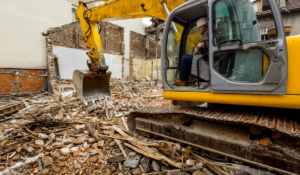
In Manatee County, a demolition permit for a residential structure can be applied for by the licensed demolition contractor or by the homeowner as owner-builder. Most homeowners working with a licensed contractor allow the contractor to pull the permit, which keeps the documentation responsibility with the party who is most familiar with the submission requirements. However, the homeowner remains responsible for several items that must be completed before or alongside the permit application.
Manatee County’s demolition permit application requires a completed permit application form, a site plan showing the structure’s footprint and setbacks, and proof of an asbestos survey for structures built before 1980. The asbestos survey must be performed by a state-licensed inspector, and the survey report must accompany the permit application — it is not something that can be done after the permit is approved. For properties in Parrish built during the 1960s through early 1980s, this requirement applies to a significant number of homes and outbuildings, and the survey timeline needs to be built into the project schedule before the permit application is submitted.
Once submitted, residential demolition permits in Manatee County typically receive review within five to ten business days for straightforward single-structure teardowns with no easement conflicts or environmental concerns. Permits for structures near jurisdictional wetlands, properties within a floodplain, or lots with documented drainage issues take longer. A licensed demolition contractor familiar with Manatee County’s review process can flag potential review delays during the estimate stage rather than after the application is submitted.
Utility Disconnects, Septic Abandonment, and What Falls on the Homeowner to Coordinate
Manatee County will not release a demolition permit until the homeowner provides written confirmation of utility disconnections. This means the homeowner must contact Florida Power and Light (or the applicable electric provider), the gas utility if applicable, and Manatee County Utilities or the private water and sewer provider to schedule the service disconnects and obtain the written confirmation each one issues.
The disconnect process takes time. Utilities schedule disconnections on their own calendars, and peak construction seasons in Parrish mean longer wait times for a field crew to come out and physically cut service at the meter or cleanout. Homeowners who contact utilities on the same day they call a demolition contractor often find themselves waiting two to three weeks for confirmation letters that could have been requested weeks earlier. Starting utility disconnect requests at the same time as the asbestos survey, before the permit application is submitted, keeps both on a parallel track rather than a sequential one.
Septic is a separate coordination item. Parrish homes on private septic systems must have the tank pumped and abandoned in place or decommissioned according to Florida Department of Health guidelines before demolition begins. In Manatee County, the septic abandonment requires a permit from the Florida Department of Health and must be inspected before the permit can be closed out. The septic contractor who performs the abandonment is different from the demolition contractor in most cases, which means the homeowner is coordinating two licensed trades simultaneously on a compressed schedule. Getting the septic contractor scheduled early is one of the most commonly missed steps in residential home demolition Parrish projects, and it is the one most likely to delay the demolition start date.
HOA review is an additional requirement in many of Parrish’s established residential communities. Demolition of a primary structure typically requires written HOA board approval, and some HOAs require a neighborhood notification period before approval is granted. Submitting to Manatee County before HOA approval is in hand creates a timing conflict that experienced contractors identify before the application is submitted rather than after the permit is issued.
What the Property Looks Like Before Demolition Versus What It Should Look Like After
Most homeowners undertaking residential demolition in Parrish are doing it for one of three reasons: clearing a lot for new construction, removing a damaged or deteriorating structure before selling, or demolishing an aging home that no longer serves the property’s intended use. In each case, the finished lot condition matters as much as getting the structure down.
Before demolition, the property typically has a standing structure, mature vegetation around the foundation, a driveway or hardscape, and underground connections to utilities and septic or sewer. After a properly scoped residential teardown by a qualified demolition company Parrish area homeowners can trust, the lot should be free of all above-grade structure, the foundation slab should be removed to grade, or below grade depending on what the builder requires; the septic tank should be abandoned or removed; and the disturbed area should be rough-graded and stabilized. What the lot should not have is buried debris, rebar stubs left at grade, shallow concrete that was not fully removed, or depressions where stumps were pulled without backfill.
These omissions are common when demolition is approached as a haul-off job rather than a complete site preparation scope. A cleared lot that looks clean from the street but has uncompacted fill, buried debris, or an unabandoned septic tank will create problems for the builder, the lender’s inspection, and the new construction permit process. The full demolition and site prep services Wingard provides in Parrish and throughout Manatee County are scoped to deliver a finished lot that a builder can work from without a secondary remediation phase. More about Wingard’s presence in the Parrish market is on the areas we serve page.
Frequently Asked Questions
How long does residential demolition take in Parrish, FL?
The physical demolition of a single-family home in Parrish typically takes one to three days depending on structure size, material type, and access. The full project timeline, including permits, utility disconnects, and septic abandonment, typically runs four to six weeks from initial contact to demolition completion. Starting the permit and utility disconnect process before selecting a demolition start date is the most reliable way to compress that timeline.
Do I need an asbestos test before home demolition in Manatee County?
Yes, for homes built before 1980. Manatee County requires an asbestos survey from a state-licensed inspector as part of the demolition permit application. The survey report must be submitted with the application. For homes built from 1980 onward, the requirement does not apply, but some contractors recommend a limited survey for structures built in the early 1980s given the lag between regulatory changes and actual construction practices during that period.
What happens to the septic system when a house is demolished in Parrish?
The septic tank must be pumped and formally abandoned or decommissioned before demolition begins. In Manatee County, septic abandonment requires a Florida Department of Health permit and a final inspection. The abandonment must be completed by a licensed septic contractor and is separate from the demolition scope. Homeowners should schedule the septic contractor at the same time as utility disconnects to avoid delays.
Can I demolish my own home in Manatee County without a contractor?
Manatee County permits homeowners to act as owner-builder for residential demolition, meaning the homeowner can pull the permit without hiring a licensed contractor. However, the homeowner assumes full responsibility for meeting all permit conditions, coordinating subcontractors, and passing inspections. For most homeowners, working with a licensed and experienced demolition contractor is the more practical approach, particularly for the debris hauling, compaction, and final grade work that follows the actual teardown.